EvoScientist: Towards Multi-Agent Evolving AI Scientists for End-to-End Scientific Discovery

Part of the EvoScientist project — harnessing vibe research with self-evolving AI scientists.
Extend it with EvoSkills — installable skill & knowledge packs that add domain-specific expertise to AI scientists.
Overview
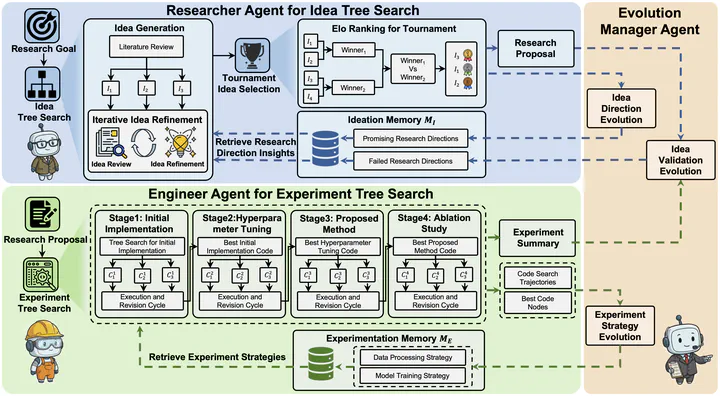
EvoScientist is an evolving multi-agent AI scientist framework that continuously improves its research strategies through persistent memory and self-evolution. It addresses a key limitation of existing AI-scientist systems: static, hand-designed pipelines that overlook promising directions, repeat failed experiments, and pursue infeasible ideas.
Framework
EvoScientist coordinates three specialized agents:
- Researcher Agent (RA): scientific idea generation.
- Engineer Agent (EA): experiment implementation and execution.
- Evolution Manager Agent (EMA): distills insights from prior interactions into reusable knowledge.
These are backed by two persistent memory modules — an ideation memory (feasible directions distilled from top-ranked ideas, plus previously unsuccessful ones) and an experimentation memory (effective data-processing and training strategies from code-search trajectories and best-performing implementations) — which the RA and EA retrieve to improve idea quality and code execution success over time.
Key Results
- Outperforms 7 open-source and commercial state-of-the-art systems in scientific idea generation, with higher novelty, feasibility, relevance, and clarity under both automatic and human evaluation.
- Substantially improves code execution success rates through multi-agent evolution, demonstrating the effectiveness of persistent memory for end-to-end scientific discovery.
BibTeX
@article{lyu2026evoscientist,
  title={EvoScientist: Towards Multi-Agent Evolving AI Scientists for End-to-End Scientific Discovery},
  author={Lyu, Yougang and Zhang, Xi and Yi, Xinhao and Zhao, Yuyue and Guo, Shuyu and Hu, Wenxiang and Piotrowski, Jan and Kaliski, Jakub and Urbani, Jacopo and Meng, Zaiqiao and others},
  journal={arXiv preprint arXiv:2603.08127},
  year={2026}
}